Clinical AI & diagnostics
Scope, build and validate AI models on clinical, imaging and laboratory data, with safety, ethics and human oversight considered from the first conversation.
We work with hospitals, diagnostic labs, research groups and biotech teams to scope, build and validate AI and computational work.
Engagements range from a focused advisory session to a full build-and-validate project. Every one starts with understanding your data and your constraints.
Scope, build and validate AI models on clinical, imaging and laboratory data, with safety, ethics and human oversight considered from the first conversation.
Target identification, protein and ligand modelling, docking and molecular dynamics for research groups and early-stage biotech.
Turn EHRs, lab records and clinical text into structured data your team can analyse, report on and model, including biostatistics for clinical trials.
Sequence analysis, phylogenetics, primer design and genomic data workflows for labs and research projects.
Practical guidance on laboratory workflows, quality processes and hospital infection control, drawn from active clinical practice.
Custom workshops for hospitals, colleges and companies, built from our EdTech bootcamps and taught by the same scientists.
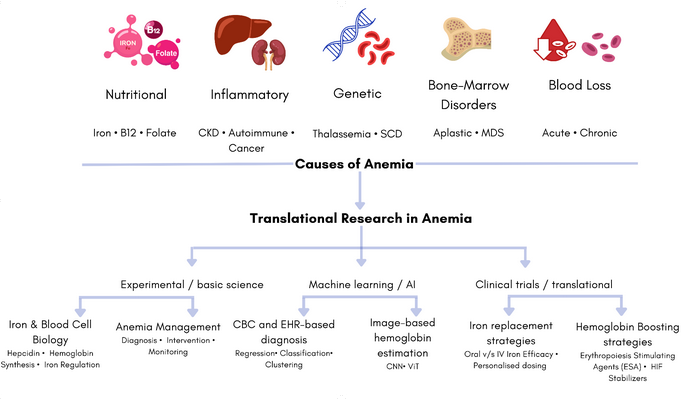
Register for the 18-month diplomaWe started where a single blood test most often falls short. Anaemia is common, chronic and has many causes, so reading it well means reading the patient’s whole clinical context.
1.92 billion
people live with anaemia, close to one in four worldwide.
Global Burden of Disease Study, 2021
US adult population data
What we found
Ferritin, the iron test ordered most often, stops tracking anaemia once inflammation is present, and adding it can make models worse. Other iron markers held up far better across patient groups, and in some groups the markers often disagreed with each other.
US adult population data, grouped by kidney function
What we found
In chronic kidney disease, anaemia runs on different biology: kidney-function markers overtake iron markers, and models lose accuracy as kidney function falls. The stakes are high, as adults with both CKD and anaemia had markedly higher mortality than those with neither.
Several datasets from around the world
What we found
Routine blood counts can flag beta-thalassaemia with high accuracy, even with simple models, using values labs report but rarely read. Alpha-thalassaemia carriers stayed hidden: no routine blood count parameter reliably separated them.
All three manuscripts are in preparation. The cohorts behind them come from outside India, so our next step is validation on Indian hospital data. If you hold haematology records, or want a pre-publication briefing, talk to us.
Discuss the researchWe are ClinEra’s biostatistics partner for a pilot clinical trial, and built its analysis pipeline end to end, from data checks to the efficacy readout. The outcome data were skewed and far from normal, the situation where standard tests give misleading answers. Our pipeline used methods that don’t rely on normality, and established the treatment’s efficacy on the data as it really was.
A clear scope up front, regular check-ins along the way, and a handover your team can build on.
Tell us the problem, the data you have and what a good outcome looks like.
We come back with an approach, deliverables, timeline and cost.
We do the work with regular check-ins and test it against your real conditions.
You receive the outputs and documentation, plus training for your team where it helps.
Short answers to what hospitals, labs and research teams usually ask before an enquiry.
Hospitals and diagnostic labs, universities and research groups, biotech and pharma teams, and health-tech companies.
Every engagement is scoped individually. After a first conversation, we send a proposal that sets out the approach, deliverables, timeline and cost. Work ranges from a focused advisory session to a full build-and-validate project.
Send a project enquiry or email queries@omnihemei.com. A member of the team replies by email to set up a first conversation about the problem, the data you have and what a good outcome looks like.
Yes. We are ClinEra’s biostatistics partner and built the analysis pipeline for its pilot clinical trial, from data checks to the efficacy readout, using methods that stay reliable when outcome data are skewed or non-normal. Read about the ClinEra work.
Our first research series, Context-Aware Haematological Intelligence, uses machine learning on routine blood tests and patient context to read anaemia more accurately. Three manuscripts are in preparation: on iron biomarkers, on anaemia in chronic kidney disease, and on telling thalassaemia apart from iron-deficiency anaemia. See the findings.
Safety, ethics and human oversight are considered from the first conversation. Scoping covers software as a medical device (SaMD) considerations, and models are validated against your real conditions before handover.
The outputs and documentation, plus training for your team where it helps. We also run custom workshops for hospitals, colleges and companies, built from our EdTech bootcamps.
Share a few details and a member of the team will reply by email to set up a first conversation.
Prefer email? queries@omnihemei.com
Thanks. A member of the team will reply by email to arrange a first conversation.